 Gracie Barra Edmonds
Leverage
Use frames, angles, and body mechanics to make technique more effective than strength alone.
THE GENTLE ART
Discover where Brazilian Jiu-Jitsu began, how Gracie Barra grew from one school in Brazil into a worldwide community, and how that legacy continues at Gracie Barra Edmonds.
MORE THAN A MARTIAL ART
Brazilian Jiu-Jitsu, commonly called BJJ, is a grappling-based martial art built around control, leverage, timing, and technique. Rather than relying only on speed, size, or strength, students learn how to manage distance, improve position, escape safely, control an opponent, and apply submissions.
Often called the Gentle Art, Jiu-Jitsu gives people of different ages, sizes, and athletic backgrounds a practical way to learn self-defense while building confidence, fitness, patience, and resilience.
“Jiu” is commonly associated with gentleness, flexibility, or yielding, while “Jitsu” means art or technique. The idea is not to meet force with force, but to adapt, create leverage, and use efficient movement.
Use frames, angles, and body mechanics to make technique more effective than strength alone.
Learn how to stay composed, protect yourself, and improve your position under pressure.
Every position presents a puzzle that develops patience, awareness, and adaptability.
Progress comes through consistency, humility, discipline, and learning from challenges.
FROM JAPAN TO BRAZIL
Brazilian Jiu-Jitsu developed through generations of teachers and students who preserved the art while adapting it through training, teaching, and competition.
Traditional Japanese grappling arts and Kodokan Judo established many of the throws, pins, controls, and submission principles that influenced modern Brazilian Jiu-Jitsu.
Kodokan judoka Mitsuyo Maeda traveled internationally demonstrating and teaching grappling. In Brazil, his instruction helped introduce Carlos Gracie Sr. to the art.
Carlos Gracie Sr. and his brothers continued practicing, teaching, and refining what they learned. Hélio Gracie became especially known for emphasizing leverage and efficiency for smaller practitioners.
Brazilian Jiu-Jitsu is now practiced for self-defense, recreation, fitness, personal development, and competition by students around the world.
JIU-JITSU FOR EVERYONE®
Master Carlos Gracie Jr. founded the first Gracie Barra school in 1986 in Barra da Tijuca, Rio de Janeiro. The academy became known by the community it served: the Gracie school in Barra— Gracie Barra .
What began as one school grew into a global organization connected by a shared teaching method, a commitment to student development, and the belief that Jiu-Jitsu should be accessible to everyone.
We train together, support one another, and grow as a team.
We practice honesty, responsibility, respect, and good character.
We pursue steady improvement on and off the mats.
OUR CONNECTION TO THE ART
In Jiu-Jitsu, lineage represents the transmission of knowledge, values, and responsibility from teacher to student. It connects the techniques practiced today to the generations that helped shape and preserve the art.
LEADING GRACIE BARRA EDMONDS
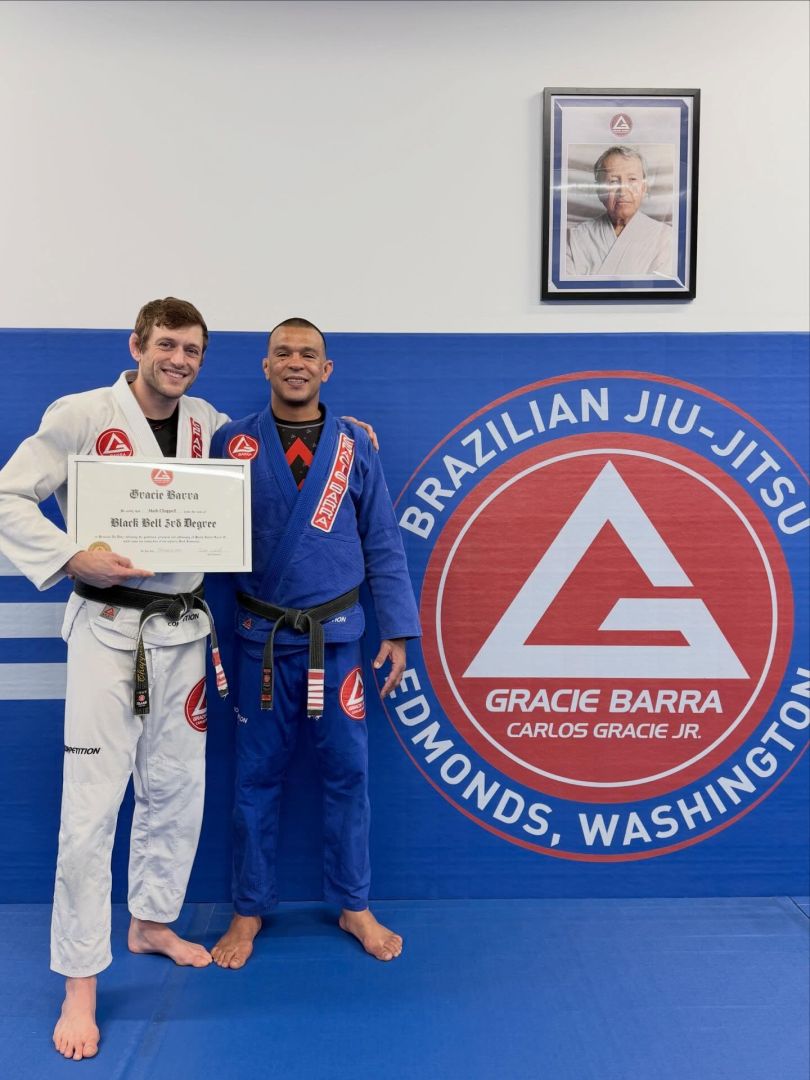
Professor Rodrigo Lopes earned his black belt under Master Carlos Gracie Jr. and Professor Márcio Feitosa. Professor Mark began training Jiu-Jitsu in 2009 and continued that tradition under Professors Rodrigo Lopes and Carlos Sievert, who jointly awarded him his black belt in 2015.
He has served as Head Instructor of Gracie Barra Edmonds since the academy opened in 2020. Today, Professor Mark carries that knowledge forward by helping children and adults develop strong fundamentals, confidence, discipline, and respect.
Meet Professor Mark →TWO WAYS TO TRAIN
Gi Jiu-Jitsu is practiced in the traditional jacket, pants, and belt. Students learn grips using the uniform as they practice takedowns, controls, escapes, and submissions.
No-Gi is practiced in a rashguard and grappling shorts or leggings. It emphasizes movement, body control, wrestling, and grips that do not depend on clothing.
COMMON QUESTIONS
“Jiu-Jitsu” can refer broadly to several related martial traditions. At our academy, we use the term to mean Brazilian Jiu-Jitsu: a grappling art centered on positional control, leverage, escapes, and submissions.
It describes the principle of using leverage, timing, and efficient movement instead of meeting strength with greater strength. Training can be physically challenging, but the strategy is based on control and technique.
No. Beginners can start at their current fitness level. Strength, endurance, coordination, mobility, and confidence develop gradually through consistent training.
No. Competition is available for students who want that challenge, but many people train for self-defense, fitness, stress relief, community, and personal growth.
Belts represent stages of technical knowledge, experience, consistency, and development. Promotions are earned over time and are based on more than simply attending a certain number of classes.
Yes. Age-appropriate classes help children develop coordination, confidence, focus, discipline, self-defense awareness, and respect in a structured environment.
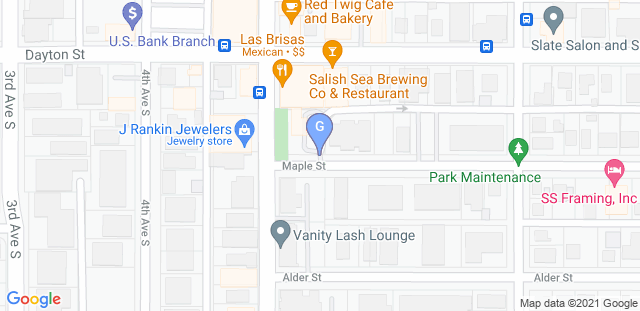
Our academy is inside the building, so it can be a little tricky to spot from the street on your first visit. Once you arrive, enter the building and look for Suite 208. Follow the hallway/signs for Gracie Barra Edmonds.
We are located near 5th and Maple, next to Barre3.